
NOTE: Due to my trip to Israel to dig at Shiloh with the Associate for Biblical Research, I’m a little late getting my end-of-month blog on the top news stories posted. Here were the top three reports in biblical archaeology from May 2023.
3. Archaeological Park to Be Developed at Ancient Israelite Capital City of Samaria
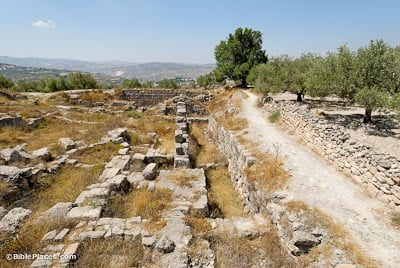
The Israeli government has announced the approval of an $8.8 million budget to develop an archaeological park at Samaria (Sebastia), located a few kilometers northwest of the city of Nablus. Samaria became the capital of the Northern Kingdom of Israel when it was built by King Omri in the ninth century BC. First Kings 16:24 says that Omri “bought the hill of Samaria from Shemer for two talents of silver, and he fortified the hill and called the name of the city that he built Samaria, after the name of Shemer, the owner of the hill” (ESV). Until now, the site has lain largely undeveloped. The new funds will be used to establish a tourist center, build new roads, map unexcavated areas, and prevent illegal activity at the site.
OFF-SITE LINK: https://www.timesofisrael.com/government-approves-8-8m-budget-to-restore-ancient-israels-capital-in-west-bank/
2. Scholars Use AI to Translate Akkadian Cuneiform into English
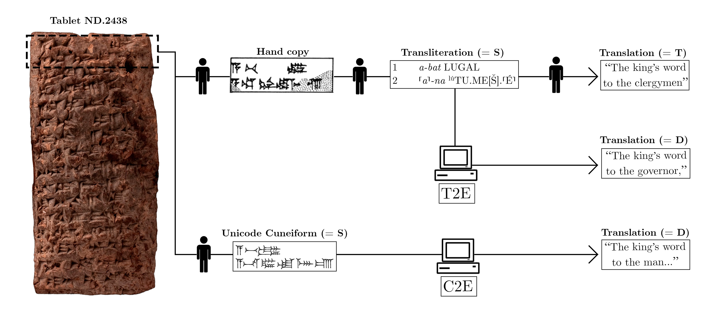
A team of researchers from Tel Aviv University and Ariel University has developed an artificial intelligence model that translates the text of Akkadian cuneiform tablets into English. They presented their work in a recent article entitled, “Translating Akkadian to English with Neural Machine Translation” in the journal, PNAS Nexus. The scholars used natural language processing methods (NLP) to automatically translate the Akkadian texts using two methods: converting the cuneiform Unicode glyphs directly to English and converting Unicode glyphs to a Latin transliteration first, then to English. Both methods achieved good results for sentences that were short or medium-length sentences (118 characters or less), but the method using the Latin transliteration first and was the most accurate. The AI model may speed up the translation of cuneiform texts and would be best used as part of a human-machine collaboration in which Assyriologists correct the initial computer translations.
OFF-SITE LINK: https://www.jpost.com/archaeology/article-741982
1. The Academic, Peer-Reviewed Article on the Mt. Ebal Curse Tablet Published
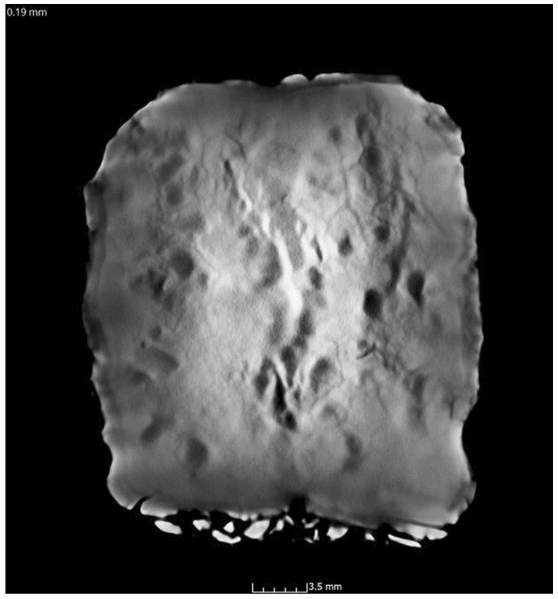
The academic, peer-reviewed article, “’You Are Cursed by the God YHW:’” An Early Hebrew Inscription from Mt. Ebal,” was recently published in the journal, Heritage Science, by a team of scholars including ABR’s Dr. Scott Stripling. The article presents the findings of their study of the lead curse tablet that was discovered by resifting material from Adam Zertal’s 1980’s excavations of the altar on Mt. Ebal. The inscription from the interior of the tablet was made visible through X-ray computed tomography and advanced data processing. The tomographic scans revealed 48 letters of 14 word sets in proto-alphabetic (= Proto–Hebrew) script occurring in a chiastic structure. The text reads:
You are cursed by the god yhw, cursed.
You will die, cursed—cursed, you will surely die.
Cursed you are by yhw—cursed (p. 7, see PDF version of the article in the link below).
The authors of the article note that a “metallurgical analysis of the tablet’s lead by Professor Naama
Yahalom-Mack at Hebrew University revealed that it derived from a mine in the Aegean (Lavrion, Greece), which was known to be in use in the Late Bronze Age” (p. 3). The fact that Late Bronze Age pottery was also found in the material that came from the altar, and the detailed analysis of the inscription itself all indicate that the lead tablet likely dates tot he Late Bronze Age II (ca. 1400–1200 BC) but to no later than ca. 1250 BC.
OFF-SITE LINK: https://heritagesciencejournal.springeropen.com/articles/10.1186/s40494-023-00920-9
BONUS ARTICLE: Ten Thoughts on the Lead Tablet
Stay Up-To-Date
Get the latest BREAKING NEWS in biblical archaeology each week here: https://biblearchaeology.org/current-events-list
 Bible Archaeology Report