
This month exciting finds from Tel Qana, Tel Shimron, and Tell Umm-el Marra were in the news. Here were the top three reports in biblical archaeology for November 2024.
3. 12-Year-Old Girl Discovers a 3500-Year-Old Scarab in Israel

A 12-year-old girl found an ancient scarab (an Egyptian amulet carved in the shape of a beetle) on the ground while hiking near Tel Qana. Incised on the scarab are two scorpions in opposite directions, a nefer symbol (meaning “good” or “chosen”) and possibly a royal staff. The scorpion is a symbol that was used to represent Serket, an Egyptian goddess of healing and protection. In the Israel Antiquities Authority’s press release (see link below), Dr. Amit Dagan, from Bar-Ilan University, who is the director of excavations at Tel Qana, and Dr. Ayelet Dayan from the Israel Antiquities Authority are quoted as saying, “This find is both exciting and significant. The scarab and its unique pictorial features, along with other finds discovered at Tel Qana with similar motifs, provide new insights into the nature of the Egyptian influence in the region in general, and the Yarkon area in particular.”
Source: https://www.iaa.org.il/en/page/news-index
2. Possible Alphabetic Inscriptions Discovered in an Early Bronze Age Tomb in Syria
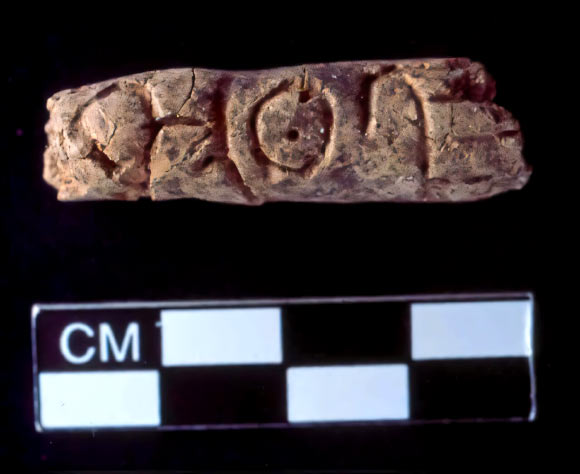
A team from John Hopkins University led by archaeologist Glenn Schwartz has unearthed possible evidence of alphabetic writing from the Early Bronze Age at Tell Umm-el Marra, the site of an ancient city in Syria. While excavating an Early Bronze Age tomb, the team found six skeletons, gold and silver jewelry, weapons, ceramic vessels, and four clay cylinders that appeared to have alphabetic writing on them. The 4,400-year-old cylinders also had holes in them, suggesting that a string was used to attach them to a vessel, and that the writing on the cylinders provided information about the contents or owner of the vessel. According to the press release (see link below) Schwartz notes, “Without a means to translate the writing, we can only speculate.” If the finger-sized cylinders do indeed bear alphabetic writing, it would push the development of the alphabetic script back by 500 years.
Source: https://hub.jhu.edu/2024/11/21/ancient-alphabet-discovered-syria/
1. Canaanite Cultic Artifacts Discovered at Tel Shimron
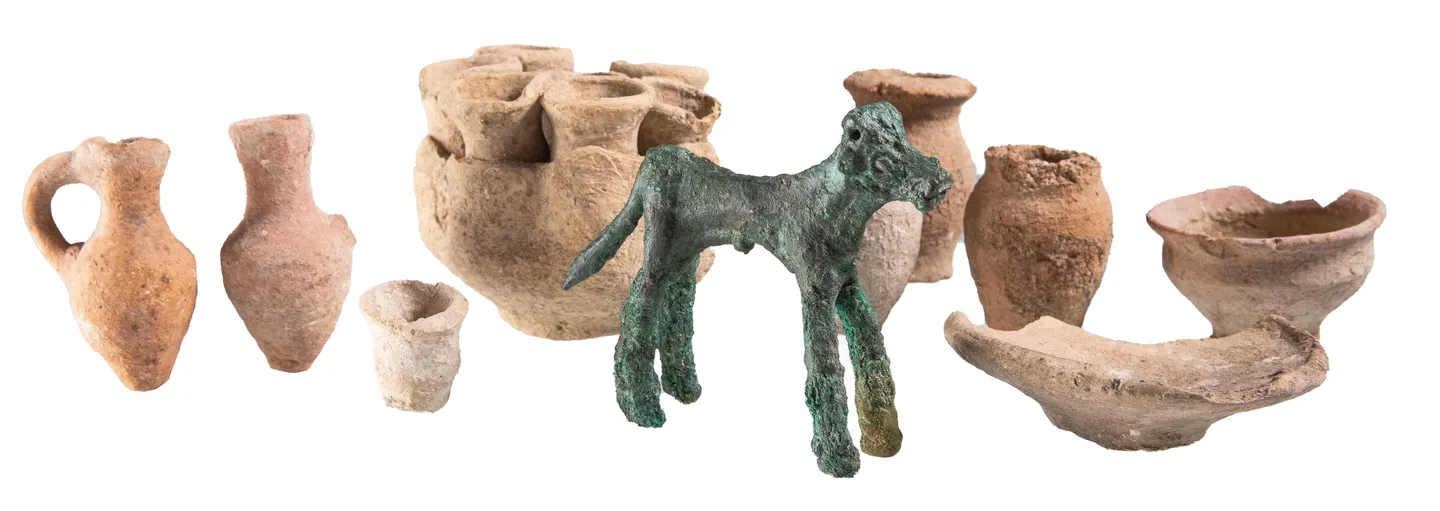
Archaeologists from Wheaton College (IL) and Tel Aviv University discovered a favissa (a cultic deposit) within a white monumental structure from the Middle Bronze Age that they excavated at Tel Shimron. While the exact purpose of the overall structure is unknown, the room that was a favissa was filled with significant cultic artifacts. Due to the lack of stratigraphy in the favissa, the archaeologists believe the artifacts were all deposited in a single ceremony or in a series of ceremonies over a short period of time. They found 40,000 charred bones, mainly belonging to sheep, cattle, and goats. They also unearthed 57,000 pottery sherds, including some from a Minoan jug—only the third Minoan ceramic find in Israel—and including many miniature jugs and bowls. Two bronze bull figurines were also discovered and are believed to be representations of either El, the chief Canaanite god or the storm god Baal.
SOURCE: https://greekreporter.com/2024/11/07/minoan-pottery-canaanite-artifacts-israel/
Stay Up-To-Date
Get the latest BREAKING NEWS in biblical archaeology each week here: https://biblearchaeology.org/current-events-list

 Bible Archaeology Report