

Every year at the end of December I look back over the past 12 months and choose the top ten discoveries from the world of biblical archaeology. As part of my work with the Associates for Biblical Research (BibleArchaeology.org), I sift through over 200 news reports per year for weekly Breaking News updates. This results in close to 50 updates each year, from which I select the ten I believe to be the most significant.
If you’re new to my yearly top ten list, here are my criteria:
- These discoveries must be directly related to people, places or events mentioned in Scripture, or to the composition of Scripture itself. For example, in Feb 2024, a team of researchers digitally unwrapped a carbonized scroll the famous library at ancient Herculaneum that was destroyed by the eruption of Mt. Vesuvius in AD 79. It turned out to be a previously unknown philosophical work by Philodemus. Important, but not directly related.
- They must be discoveries or new studies about discoveries, as opposed to announcements.
- I only consider discoveries/studies that have been publicized through an official announcement by a Ministry of Antiquities or from a licensed archaeological dig with the expectation that a peer-reviewed article will follow, or ones that are published in peer-reviewed or other reputable journals.
Honorable Mention

I’d like to begin with an honorable mention, which goes to the Associates for Biblical Research ant their dig at Shiloh (Full disclosure: I am on the dig staff for ABR’s dig at Shiloh). While their team was smaller this year due to the conflict in the Middle East, they continued to make headway in their goal of understanding the history of the site. Significant finds this past year include a faience pomegranate bead, a piece of gold inscribed with a man’s face, and a bulla. The team digging in the gate complex also unearthed paving stones in situ and gate pillars that were still standing to their original height. No official press release was issued by ABR for these discoveries, but they are significant nonetheless, and deserve a mention.
Now, on the the list: here are the top ten discoveries in biblical archaeology in 2024.
10. Archaeologists Claim to Have Found the Villa of Caesar Augustus Near Mt. Vesuvius (April 2024)
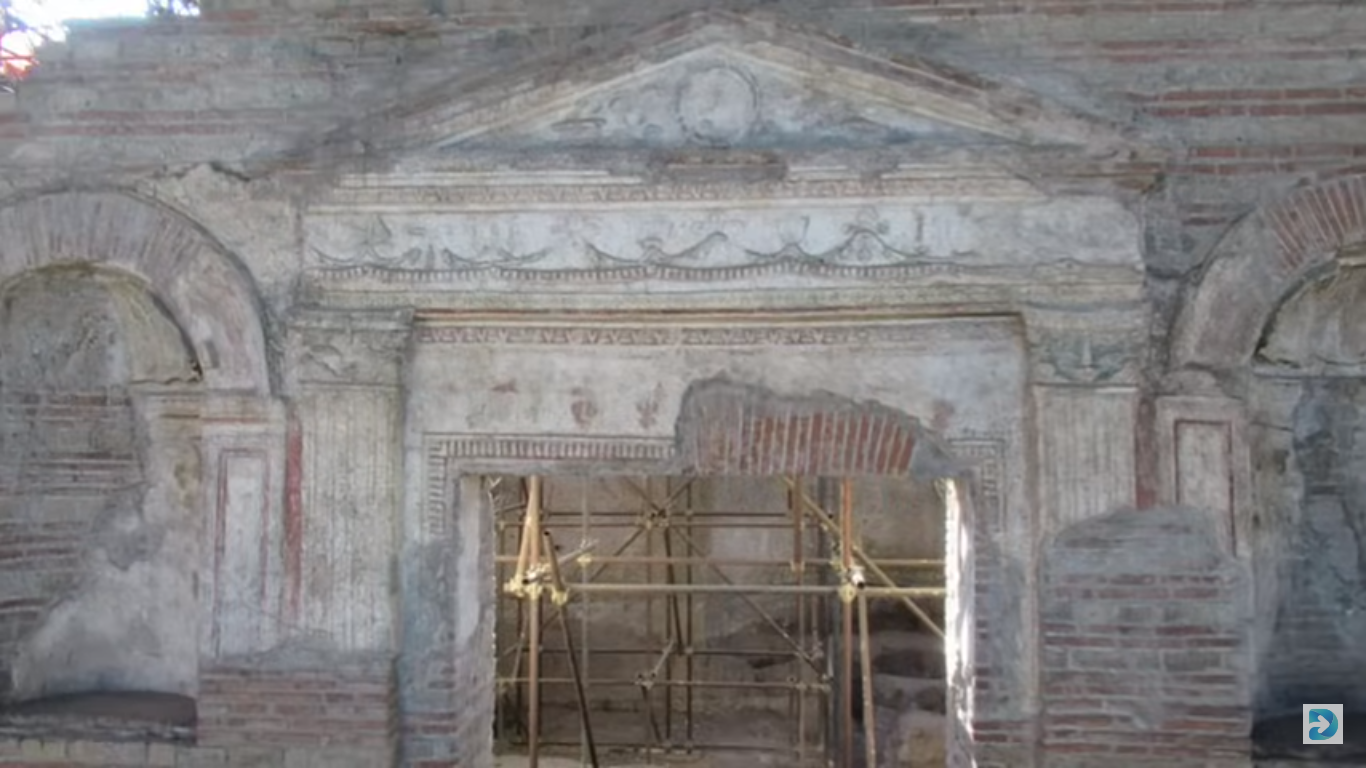
Japanese archaeologists from the University of Tokyo recently announced new data that they say confirms that a villa in Somma Vesuviana on the northern slope of Mt. Vesuvius once belonged to Caesar Augustus. From the work of several ancient writers, including Tacitus and Suetonius, we know that Augustus died on the northern side of Vesuvius and that his villa there was later dedicated as a temple for his imperial cult. The villa in Somma Vesuviana was first discovered in the 1930’s, but recent excavations, have revealed that this villa was built atop an earlier complex. Radiocarbon dating and chemical analysis of volcanic layers have revealed that the earlier structure dates to the reign of Augustus. A large temple-like structure was later built on top of the villa site, providing further evidence that the first-century villa may have once belonged to Augustus. Caesar Augustus is named in Luke 2:1 as the Roman emperor ruling at the time of Christs’ birth.
9. New Archaeomagnetic Study Provides Date for the Construction of the Ishtar Gate in Babylon (Jan. 2024)
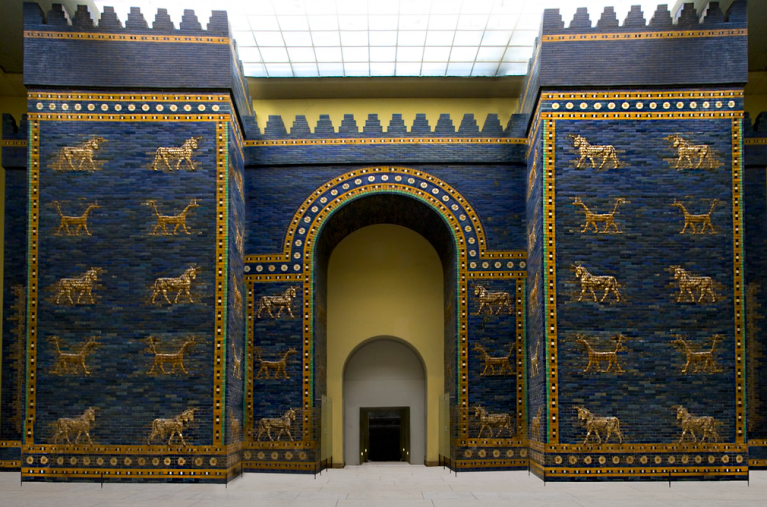
In a new article published in the journal PLOS ONE, a team of researchers has dated the construction of the Ishtar Gate in Babylon to ca. 583 BC using archaeomagnetism. The team obtained samples from five fired mud bricks from all three construction phases of Ishtar Gate and analyzed the geomagnetic field of each sample. The results indicated that there were no significant chronological gaps between the construction phases, as previously thought. The new study clarifies that there was only one construction phase and that the gate was completed in 583 BC (+/- 22 yrs), within the lifetime of Nebuchadnezzar, who reigned from 605 to 562 BC. According to the Bible, King Nebuchadnezzar invaded the land took captives from Judah into exile in Babylon on three different occasions: in 605 BC (when the prophet Daniel was taken), in 597 BC (when the prophet Ezekiel was deported) and finally in 587/586 BC, when Jerusalem was destroyed (2 Kgs 25:1–11). So Daniel and the exiles likely witnessed the construction of the Ishtar Gate.
8. One Hundred and Eighty Inscribed Jar Handles Discovered in an Administrative Complex South of Jerusalem (October 2024)
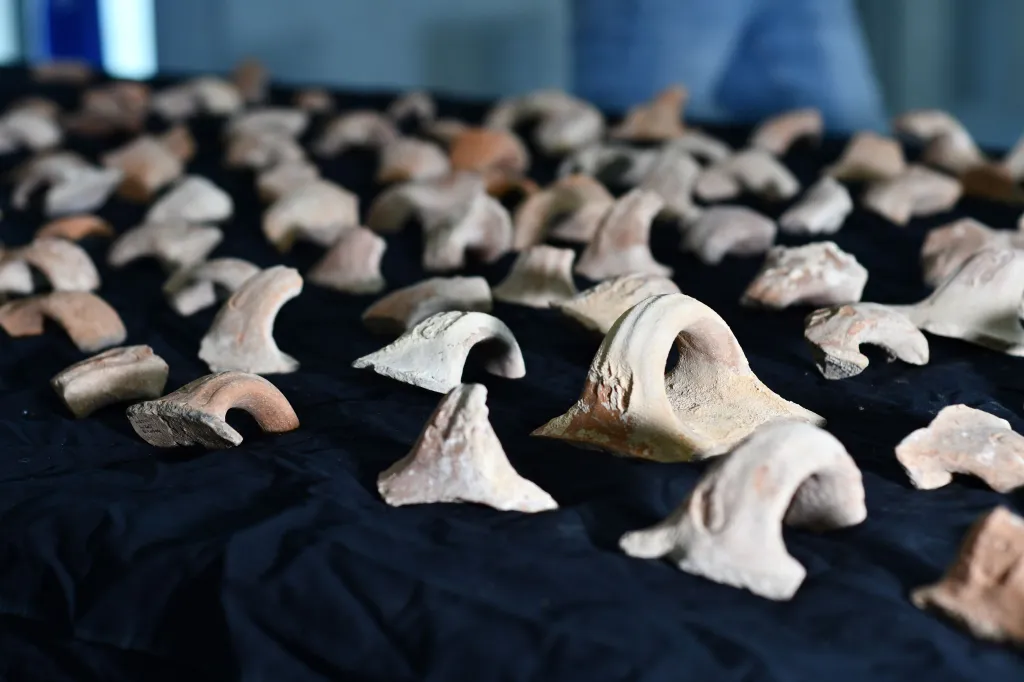
The Israel Antiquities Authority (IAA) recently announced the discovery of 180 inscribed jar handles from an administrative complex dating to the reign of Hezekiah, or possibly that of his father Ahaz. The team led by the IAA unearthed two administrative buildings, one constructed on top of the other. The first was in use during the last third of the eighth century BC and archaeologists discovered 17 jar handles inscribed with private names within it. In the subsequent building, many handles were discovered that bore the inscription lmlk, meaning “to the king.” The excavators have interpreted the private seals as evidence of a different form of administration prior to the destruction of the first building, which they attribute to the Assyrians.
7. Canaanite Cultic Artifacts Discovered at Tel Shimron (November 2024)
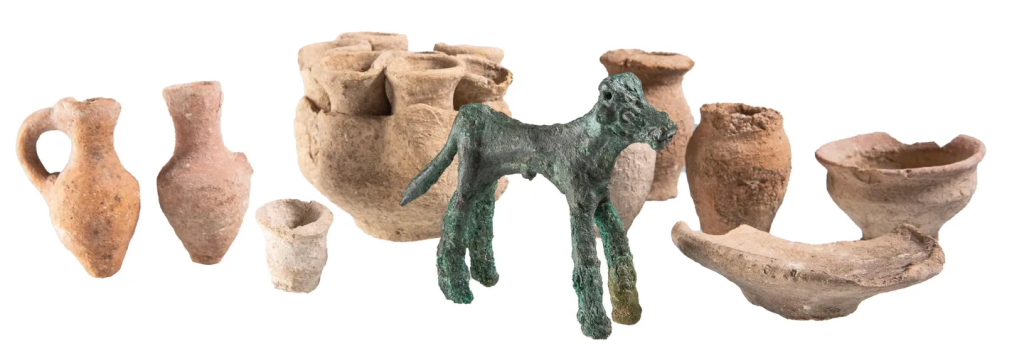
Archaeologists from Wheaton College (IL) and Tel Aviv University discovered a favissa (a cultic deposit) within a white monumental structure from the Middle Bronze Age that they excavated at Tel Shimron. While the exact purpose of the overall structure is unknown, the room that was a favissa was filled with significant cultic artifacts. Due to the lack of stratigraphy in the favissa, the archaeologists believe the artifacts were all deposited in a single ceremony or in a series of ceremonies over a short period of time. They found 40,000 charred bones, mainly belonging to sheep, cattle, and goats. They also unearthed 57,000 pottery sherds, including some from a Minoan jug—only the third Minoan ceramic find in Israel—and including many miniature jugs and bowls. Two bronze bull figurines were also discovered and are believed to be representations of either El, the chief Canaanite god or the storm god Baal. Baal worship is recorded throughout the Old Testament.
Source: https://greekreporter.com/2024/11/07/minoan-pottery-canaanite-artifacts-israel/
6. 3,800-Year-Old Textile Found in Judean Desert Was Dyed Using an Insect (June 2024)
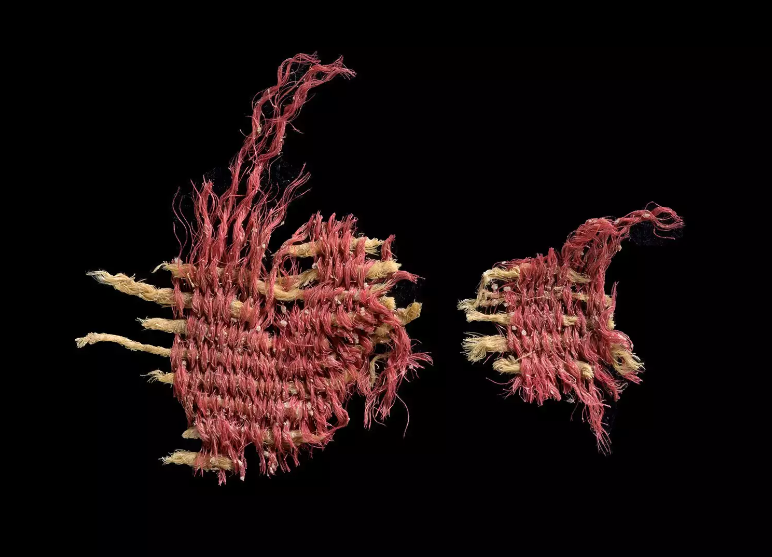
Israeli researchers recently published an article in the Journal of Archaeological Science: Reports in which they identify the source of the red dye used in a 3,800-year-old piece of cloth discovered in 2016 in a cave in the Judean Desert. The researchers tested he fabric and identified the origin of the dye as an insect called Kermes vermilio which is found on the kermes oak tree. In the ancient world, the female insects were collected during one month in the summer, after they had laid their eggs but before the eggs hatched, since this was when they had the most dye in their bodies. The researchers further connected this insect with the biblical “scarlet worm.” In the Old Testament, the Hebrew words used for this term are sometimes translated as “worm” (ie. Dt 28:39) and sometimes as “crimson,” as in Isaiah 1:18. The scarlet color from this insect was also to be used in the making of the priestly garments (Ex 28). Professor Zohar Amar of Bar-Ilan University noted: “The biblical association of this color with a living creature demonstrates impressive zoological knowledge, considering that female scale insects lack legs and wings, to the extent that some Greek and Roman naturalists even mistook them for plant granules.”
5. Scholar Claims to Have Located the Camps of the Assyrian Army at Lachish and Jerusalem (June 2024)

In a recent issue of the journal Near Eastern Archaeology (Vol. 87, no. 2), scholar Stephen C. Compton claims to have located Assyrian siege camps at Lachish, Jerusalem and other locations from Sennacherib’s campaign of 701 BC (2 Kgs 18 –19; 2 Chr 32; Is 36 –37). Compton compared details in the famous Lachish reliefs from Sennacherib’s palace with the landscape seen in early aerial photos prior to urbanization and identified the oval-shaped camp the Assyrians used when attacking the city. He also discovered that this site had pottery sherds from the eighth century BC, but had no evidence of occupation before that, nor for hundreds of years afterward. Compton also noted that the Arabic name for the site was Khirbet al Mudawwara, meaning “The Ruins of the Camp of the Invading Ruler.”
He then noted an oval-shaped site near Jerusalem on a hill named Jebel el Mudawwara (“The Mountain of the Camp of the Invading Ruler”). He believes this site to be the Assyrian camp used during the siege of Jerusalem in the days of Hezekiah, and he further identifies the location with the former city of Nob, based on Isaiah’s description of the Assyrians stopping at Nob when they attacked Jerusalem (Is 10:24–32). This hill is now called Ammunition Hill due to its use as a British ammunition depot in the 1930’s.
4. Late Bronze Age Canaanite Shipwreck Discovered off the Coast of Israel (June 2024)
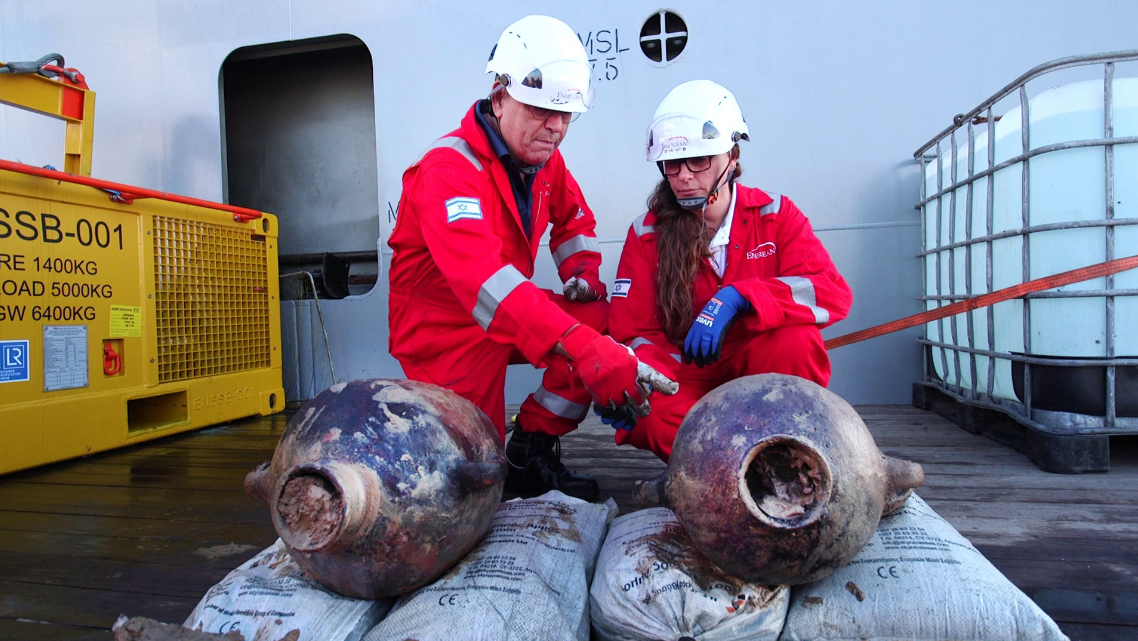
The world’s oldest deep-sea shipwreck was recently discovered in the middle of the Mediterranean Sea by an energy company surveying the seafloor ahead of a gas field development. The ship sank approximately 3300 to 3400 years ago 56 miles (90 km) off of the northern coast of Israel and lies at a depth of 1.1 miles (1.8 km). A robotic submersible was used to investigate the shipwreck and bring up two jars, which have been identified as typical Canaanite storage jars from the Late Bronze Age. Organic material was taken from the jars and has been sent to the Israel Antiquities Authority laboratories for residue analysis. The cause of the shipwreck is unknown, but it may have been caught in a storm or sprung a leak on its way to one of the Phoenician port cities of Tyre, Sidon or Byblos. The discovery demonstrates that mariners in the fourteenth and thirteenth centuries BC could sail in the middle of the sea, out of site of the shoreline, contrary to what many scholars previously believed. It also helps us better understand the trading network from Caanan across the Mediterranean throughout the period of the Conquest and the Judges.
3. Phoenician Gold Pendant Discovered in Jerusalem (February 2024)

A 3000-year-old Phoenician gold pendant was recently announced in Jerusalem. The artifact was originally discovered in 2012 in the Ophel excavations directed by Eilat Mazar. It is made of electrum (a naturally occurring alloy of gold and silver), is basket-shaped, and measures 4 x 4 x 2 millimeters. The artifact is similar to other basket pendants known from Phoenician sites, and, based on the archaeological context in which it was found, it was dated to the tenth century BC. This discovery could be seen as supporting the biblical record that there were Phoenician workers in Jerusalem who constructed David’s palace (2 Sm 5:11), although some scholars have pointed out that the artifact may have simply arrived via trade, as the Phoenicians are known to have been great traders in the ancient world.
2. Authors of New Radiocarbon Study Claim to Provide Absolute Chronology for Jerusalem (May 2024)
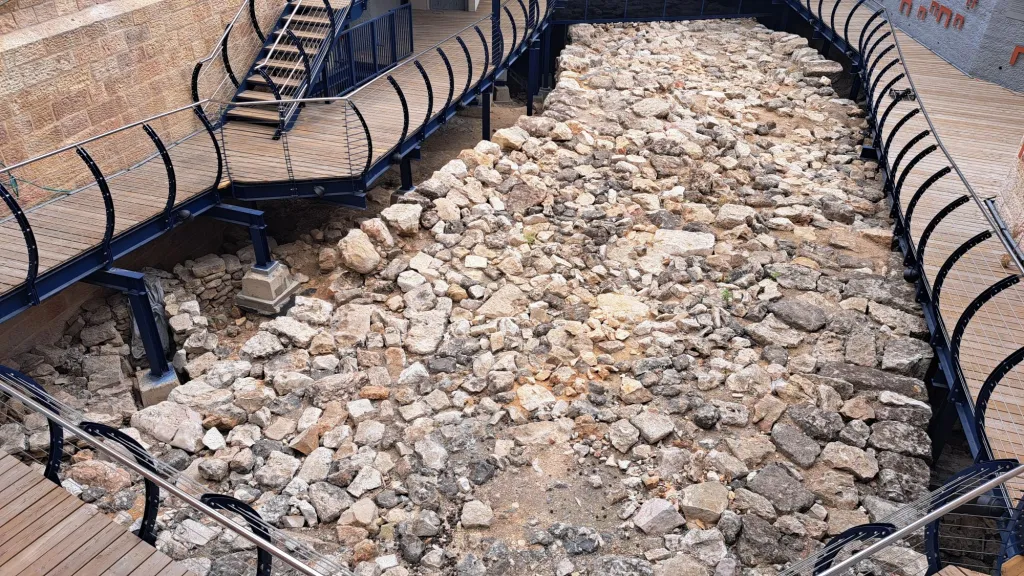
A team of Israeli scholars recently published an article in PNAS, the journal of the National Academy of Sciences, in which they present new radiocarbon data that they claim provides an absolute chronology for Jerusalem in the Iron Age. The team carbon tested 103 samples of seeds and other remains from five sites around ancient Jerusalem. Moreover, they created a new method of testing to more precisely correlate the results with specific years, which allowed them to reconstruct the history of Jerusalem from 1200 BC (period of the Judges) to 587/6 BC, when the city was destroyed by the Babylonians. One of the major findings was that Jerusalem was much more heavily populated and urbanized in the 12h through 10th centuries BC than some liberal scholars previously thought. This would align with the biblical description of Jerusalem, particularly during the days of David and Solomon. Another conclusion was that the Broad Wall in the Jewish Quarter of Jerusalem, also known as Hezekiah’s Wall, was likely built during the reign of Uzziah, who Scripture says built fortifications in Jerusalem (2 Chr 26:9).
1. 2,700-Year-Old Seal Discovered in Jerusalem (August 2024)
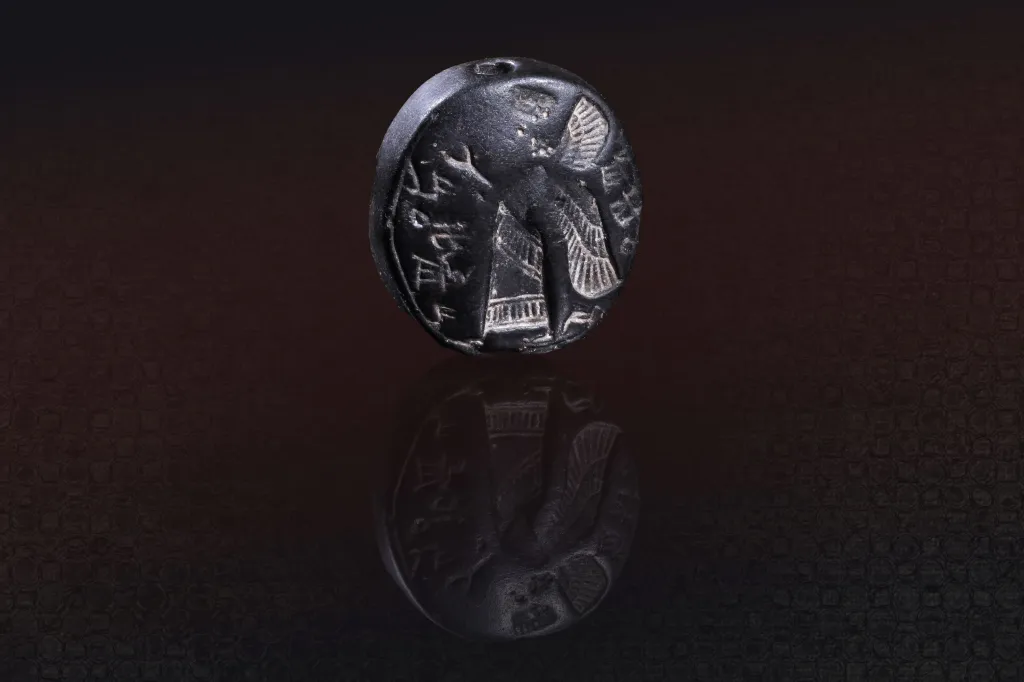
A beautiful 2,700-year-old stone seal was unearthed in excavations in the Davidson Archaeological Garden near the Southern Wall of the Temple Mount. The black stone seal depicts a winged figure and bears the paleo-Hebrew inscription, “LeYehoʼezer ben Hoshʼayahu.” It has a hole drilled through it from top to bottom so that it could be attached to a chain or worn around one’s neck. The spectacular winged figure contrasts with inscription, which is relatively sloppy. Scholars hypothesize that the seal once belonged to an important figure in the courts of the Kingdom of Judah named Hoshʼayahu and that upon his death, his son, LeYehoʼezer, inscribed his name and his father’s on it. These names appear in the Bible: in 1 Chronicles 12:6, Joezer/Yo’ezer (an abbreviate form of Yeho-ezer) is listed as one of David’s mighty men and in the book of Jeremiah (43:2) Hoshʼaya (a shortened form of Hoshʼayahu) is one of the insolent men who accuses the prophet of lying. This indicates these names were used in the Iron Age in the kingdom of Judah as the Bible describes. Furthermore, if it was indeed Yehoʼezer himself who engraved the names on the seal, it is evidence of literacy at this period in Judah’s history.
Conclusion
Top ten lists, by their very nature, focus on extraordinary finds. There are hundreds of excavations going on every year in the lands of the Bible. Each find contributes to our understanding of the way people lived in the ancient world. For over 150 years, archaeology has been helping to illuminate and affirm details in the biblical text, demonstrating that the Bible is historically reliable.
Part of the fun of doing a top ten list like this is comparing my list to those compiled by others. So take some time to check out Gordon Govier’s list at Christianity Today and Todd Bolen’s list at BiblePlaces.com
 Bible Archaeology Report