
Here were the top three discoveries from the world of biblical archaeology in June 2025.
3. Stunning Sarcophagus Depicting Dionysus and Hercules Discovered at Caesarea Maritima
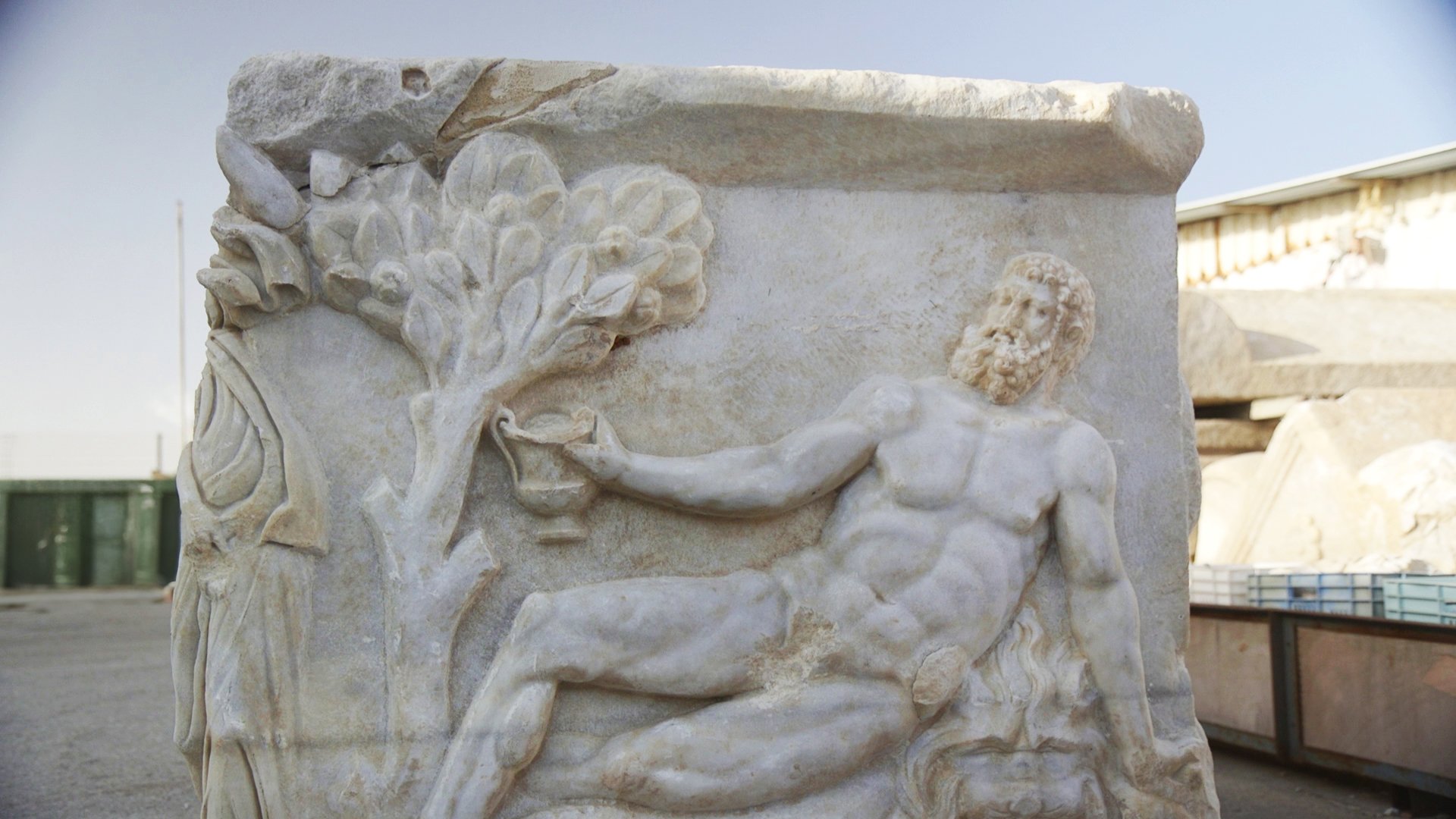
A 1,700-year-old marble sarcophagus (coffin), carved with an intricate scene depicting a drinking contest between Dionysus (or Bacchus), the god of wine, and the mythical hero Heracles (Hercules), was recently unearthed at Caesarea. This is the first time a depiction of the Dionysus and Hercules wine competition scene has been discovered on a sarcophagus in the region. The famous scene is known from mosaics at Zippori and Syrian Antioch, but—until now—it had not appeared on burial coffins in Israel. The sarcophagus was discovered in an area outside the walls of Caesarea; this area leading into the city has proven to be richer in archaeological material than previously thought. While the Greek god Dionysus is not explicitly mentioned in the Bible, some scholars believe Paul’s condemnation of those who drank the cup of demons (1 Cor. 10:20–21) is a veiled reference to the cult of Dionysus, which was prominent in Corinth. Moreover, a man named Dionysius the Areopagite—no doubt named after the Greek god—came to faith through Paul’s ministry in Athens (Acts 17:34).
Source: https://www.iaa.org.il/en/page/news-index (See “A spectacular and rare Roman sarcophagus was uncovered in Caesarea” [June 9, 2025])
2. Ceremonial Street Unearthed at Samaria-Sebaste
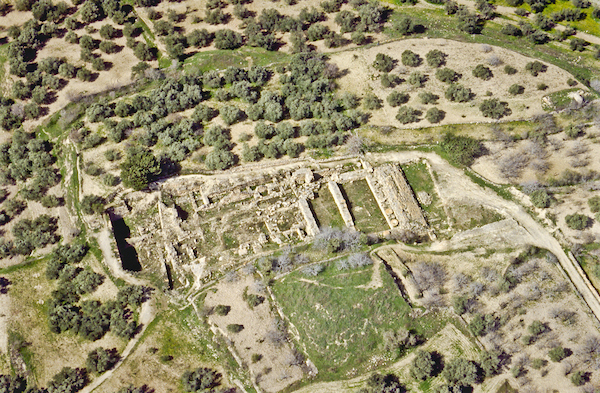
Excavations have been renewed at ancient Samaria-Sebaste. The site was first excavated by a team from Harvard University in the early 1900’s. A team led by Uzi Greenfeld, an archaeologist representing the archaeology department of the Israeli Civil Administration, has renewed excavations. During the first two weeks, a stone pavement from a ceremonial street leading from the Herodian city’s center to the main gate was unearthed. It was once lined with decorated columns that now lie toppled beside the street. Also discovered was an ornate stone base that likely once held a monument, although this is missing. The archaeologists believe it may have marked the entrance to a tower or temple. In the Iron Age, King Omri purchased the hill of Samaria to build a capital city for the Northern Kingdom of Israel (1 Kgs 16:23–24). Centuries later, Herod the Great rebuilt the city and renamed it Sebaste, the Greek equivalent of Augustus, in honor of the Roman emperor.
1. New Study Proposes Earlier Composition Dates for Some Dead Sea Scrolls

According to a new study in the journal PLOS One entitled, “Dating Ancient Manuscripts Using Radiocarbon and AI-Based Writing Style Analysis,” a third of the Dead Sea Scrolls (DSS) manuscripts tested were composed earlier than initially thought. The research team created an artificial intelligence program, named “Enoch,” that was trained to predict dates based on the handwriting style features of the manuscripts and carbon-14 results. These dates were then compared with the dates traditionally assigned to the scrolls based on paleography. Thirty DSS manuscripts were initially tested, with twenty-six providing valid results. In one-third of the samples (9 out of 26), the dates provided by Enoch and radiocarbon dating were earlier than the proposed palaeographic dates. This includes DSS manuscripts such as 4Q2 (Genesis), 4Q27 (Numbers), and 4Q30 (Deuteronomy). The results for 4Q114 (Daniel) pose a problem for scholars who date the composition of Daniel to ca. 160 BC, since the radiocarbon dates indicate 4Q114 was likely composed earlier (ca. 230–160 BC). The fact that the book of Daniel was copied, circulated, and accepted as canonical already in the second or third century BC suggests an even earlier composition date.
Source: https://journals.plos.org/plosone/article?id=10.1371/journal.pone.0323185
Stay Up-To-Date
Get the latest BREAKING NEWS in biblical archaeology each week here: https://biblearchaeology.org/current-events-list

 Bible Archaeology Report