
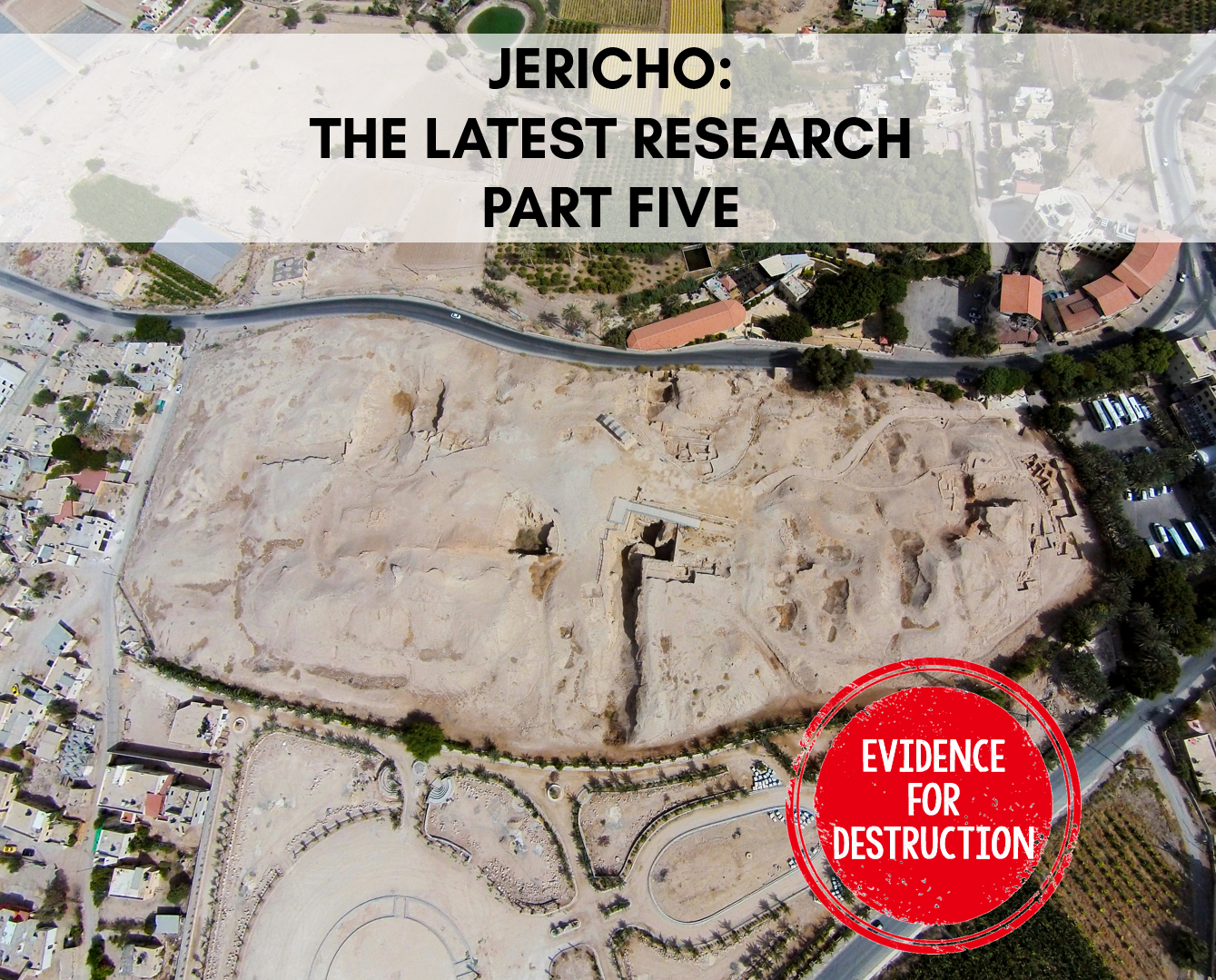
This is the fifth and final article in my series on the latest archaeological evidence from Jericho. Within this series, I provide an overview of my master’s thesis research, indicating that City V, not City IV, was the Jericho that Joshua and the Israelites conquered. It was occupied, fortified, and destroyed in the Late Bronze Age within the timeframe indicated by the biblical data.
In Part One, I set the stage by reviewing the various excavations at Jericho and introducing my thesis that Jericho City V, not City IV, is the stratum associated with Joshua’s conquest.
In Part Two, I outlined my chronological window approach to dating the conquest. I maintain that the conquest occurred sometime between 1426 and 1346 BC.
In Part Three, I presented some of the evidence for the occupation of Jericho City V within this conquest window.
In Part Four, I described the fortifications of Jericho City V, as revealed by the latest archaeological data from Lorenzo Nigro’s team.
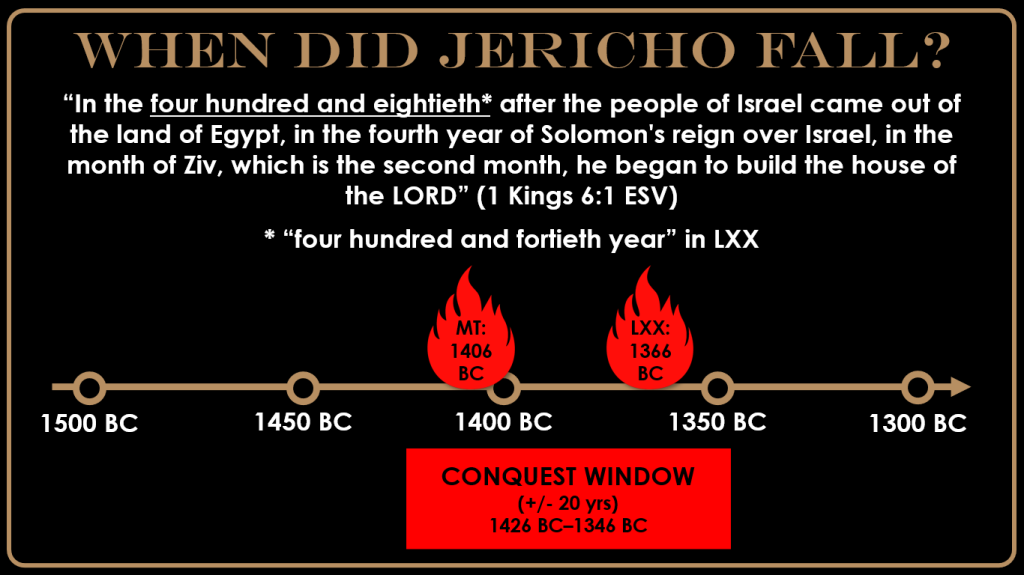
In Part Five, I will summarize the evidence for the destruction of the first phase of City V, and show how it aligns with the biblical description of the fall of Jericho.
You can find a more thorough treatment of the evidence from City V in my book, Joshua’s Jericho: The Latest Archaeological Evidence for the Conquest, which Trowell Press recently published. It is available from Amazon here: https://a.co/d/iCUWXQW.
The book of Joshua describes two features of the destruction of Jericho that might be found through archaeological excavation. First, Joshua 6:20 records that “the walls fell flat.” So evidence of collapsed mudbrick walls might be found. Secondly, according to Joshua 6:24, “they burned the city with fire and everything in it.” This may mean a site-wide conflagration, or it may be hyperbolic rhetoric. Kenneth Kitchen has noted the use of rhetoric in the book of Joshua, which was a regular feature of military reports throughout the Ancient Near East in the second and first millennium BC.1 For example, Joshua 10:20 states that the Israelite army struck the Amorites “with a great blow until they were wiped out,” implying a literal annihilation. Yet the verse goes on to talk about a remnant who escaped. Kitchen rightly cautions about interpreting “all” and “everything” literally without recognizing and understanding the ancient use of rhetoric in summations.2 Read with this in mind, the burning of Jericho and “everything in it” need not imply a site-wide conflagration. Certain areas of the city, such as the gate and the palace area, may have been symbolically burned.
Is there evidence of such destruction at Jericho City V dating within the chronological window (1426 BC to 1346 BC) for the fall of the city? I believe there is.
Evidence of Collapsed Mudbrick Walls
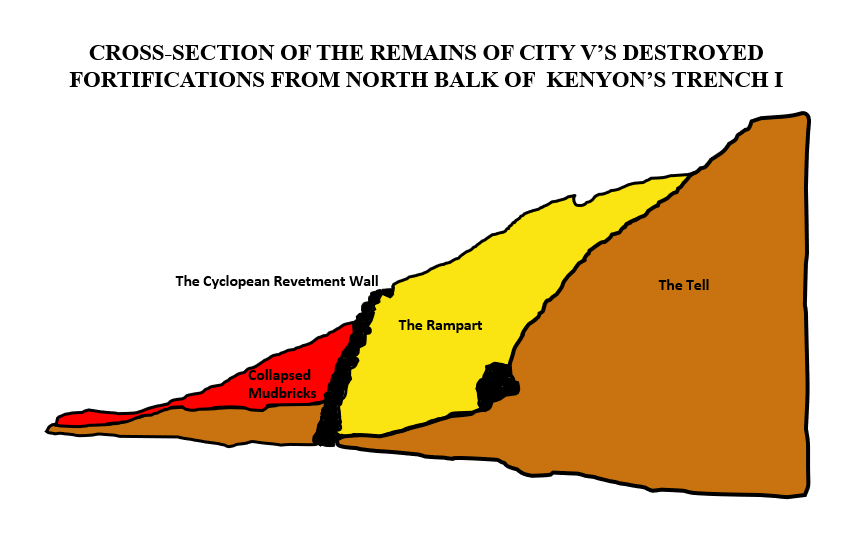
As I noted in Part Four, the citizens who rebuilt Jericho in the Late Bronze Age reused the Middle Bronze Age stone Cyclopean wall by adding a mudbrick superstructure on top of it. In describing the Late Bronze Age fortifications of City V, Nigro writes, “The LB mudbrick wall was recognized by Kenyon in the trenches she excavated at the western (Trench I), northern (Trench II) and southern (Trench III) sides of the tell.”3 This is a remarkable claim, as Kenyon insisted she never found the remains of Late Bronze Age mudbrick city walls, as she believed they had been destroyed by erosion.4 To what is Nigro referring?
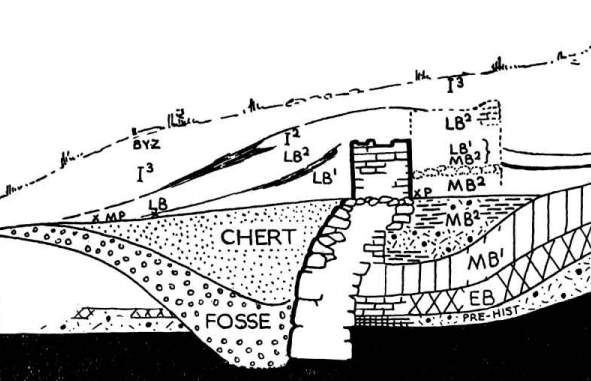
Nigro cites Kenyon’s excavation report, including the mudbrick remains in Trench I.5 There, Kenyon noted the revetment [Cyclopean] wall with mudbrick remains atop in Stage XLIII, Phase lxi and fallen red bricks piling nearly to the top of the revetment in Stage XLIV, Phase lxiv.6The fallen mudbricks from this phase in Trench I can be clearly seen in the cross-section diagram published in Kenyon’s final excavation report.7 To be clear, Kenyon associated these collapsed walls with City IV, which was the Middle Bronze Age city. Nigro, based on his own excavations and research, has redated these, associating them with the Late Bronze Age City V.8 If he is correct, these are likely the remains of the walls of Jericho that fell before Joshua’s army.

Bryant Wood was the first to associate these fallen mudbricks with Joshua’s Jericho, although he associated them with City IV, as Kenyon had. Still, his analysis of the way in which the fallen mudbricks align with the biblical description is valid when applied to City V:
When the wall was deposited in this fashion at the base of the tell, the collapsed mudbricks themselves formed a ready ramp for an attacker to surmount the revetment wall. According to the Biblical account, the Israelites who encircled the city “went up into the city, every man straight before him” (Joshua 6:20).9
Evidence of Destruction Within City V
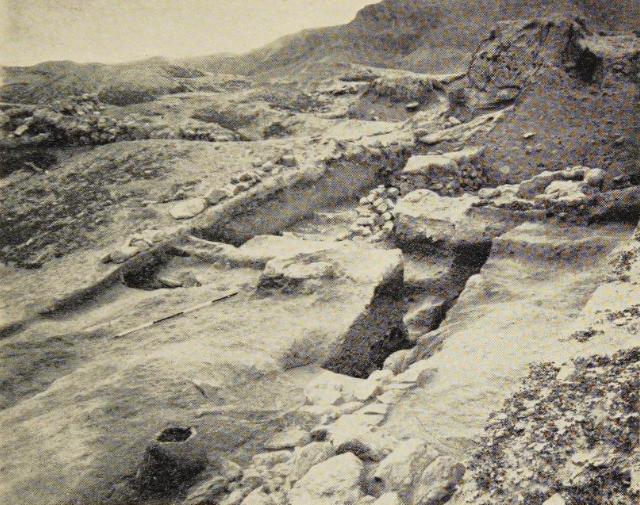
Kenyon excavated the remains of a Late Bronze Age house on Spring Hill. Her final excavation report lists a destruction level in phase liv-lv.10 While she provided no specifics as to the nature of this destruction, she did provide a date for it. She dated this destruction to the third quarter of the fourteenth century, which she noted suited neither the proponents of a 15th-century BC conquest, nor those who supported a 13th-century BC conquest.11 However, her date falls within my chronological window for the fall of Jericho.
Evidence for Destruction by Fire
Garstang’s excavations revealed evidence of destruction by fire dating to the Late Bronze Age outside and at the base of the Middle Bronze Age Cyclopean wall, where he noted an “outer layer of burnt debris.”12 While Garstang did misdate the double brick walls further north (believing they were from the Late Bronze Age, while in fact they were from the Early Bronze Age), Nigro notes that Garstang correctly dated remains of the Late Bronze Age mudbrick walls atop the Cyclopean wall.13 Thus, the burnt destruction layer identified by Garstang at the base of the Cyclopean wall correctly dates to roughly the middle of the Late Bronze Age
Furthermore, in his 2021 ASOR presentation, Nigro noted further evidence of destruction of the City V by fire: “The Late Bronze ended in some kind of conflagration, and then there is a gap…The Late Bronze Age ends in a fierce destruction, which is, however, not clearly documented, as it was excavated by the first two excavations in a non-reconstructable way.”14
Unfortunately, Nigro has not definitively dated this destruction by fire. While he believes people used the Middle Building in the 13th century BC, he also notes “a dramatic draught of archaeological evidence” in this century, which is often interpreted as the abandonment of the site.15 This suggests that this destruction by fire likely occurred sometime in the 14th century BC, when the primary Late Bronze Age occupation occurred.16 Again, we see destruction by fire, likely within the timeframe established by the biblical chronological data.
Lack of Evidence of Destruction
While Jericho City IV has a significant, site-wide destruction layer, the destruction of City V is more modest in nature. Why is there not more evidence for this destruction?
First, the Late Bronze Age archaeological remains have simply been erased by erosion over time. At most points on the tell, erosion has gone below the Middle Bronze Age level, except for on the eastern slope of the tell, where two Late Bronze Age structures have been excavated.17 Kenyon noted, “It is a sad fact that of the town of the Late Bronze Age, within which period the attack of the Israelites must fall by any dating, not a trace remains. The erosion which has destroyed much of the defenses has already been described.”18
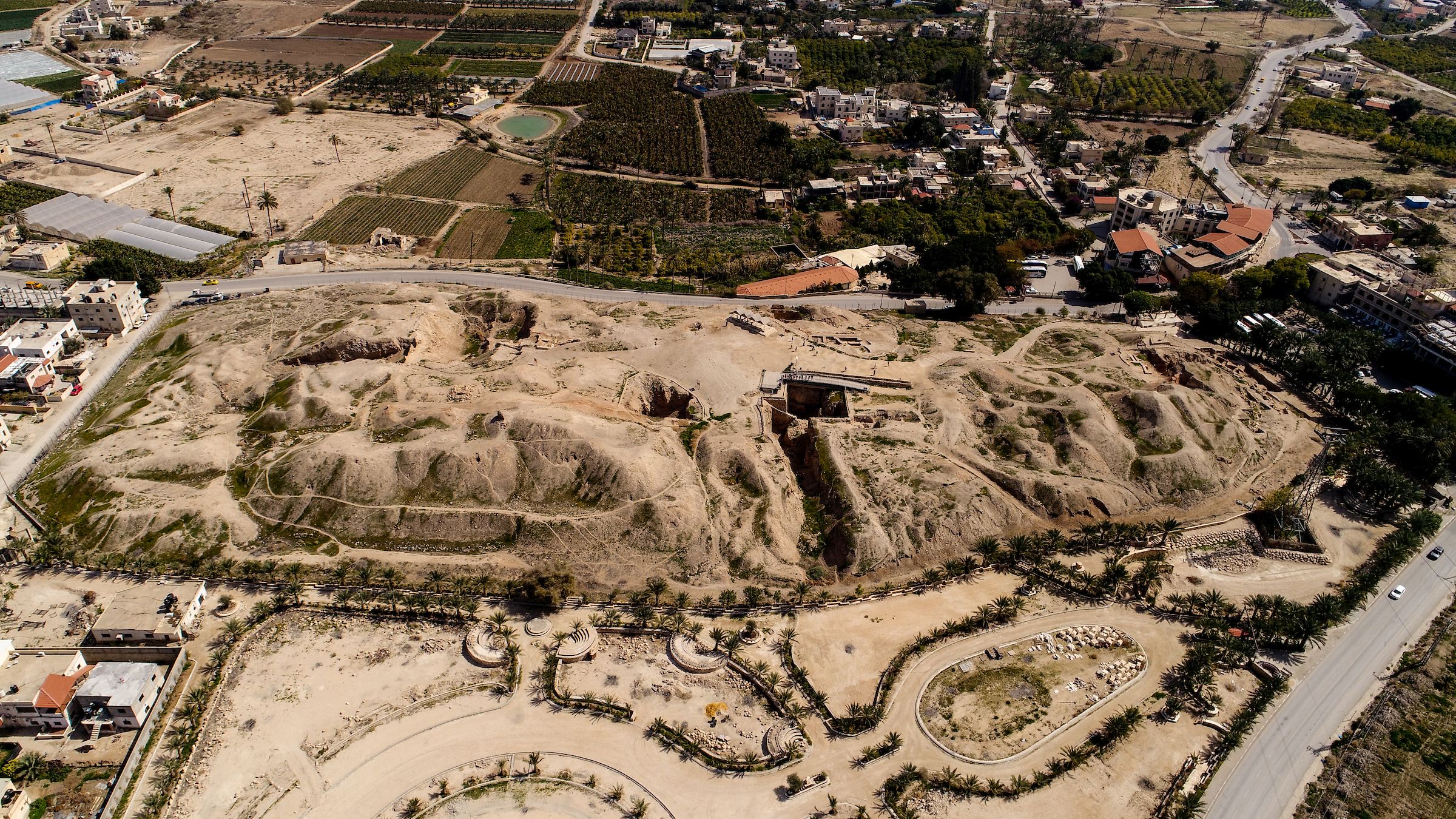
Secondly, much of the evidence for City V was erased by subsequent occupation at the site. Nigro notes that the Late Bronze Age layers from the tell were cut away by the building activities in the IA, Hellenistic, Roman and Byzantine periods.19 When a new city was built, the previous remains were scraped aside to form a level building area on which to construct new structures. This may explain why, apart from the palace/residency area, LB layers were predominantly unearthed on the flanks of the tell.
Conclusion
While there is not an overabundance of archaeological evidence, this does not imply a lack of destruction. One ought to remember this maxim: absence of evidence is not evidence of absence. For example, there is scant evidence for LB occupation at Jerusalem, and yet the Amarna tablets indicate it was a Canaanite city-state of some significance, such that its king would write to the Pharaoh of Egypt. Further, only a relatively small portion of the ancient city of Jericho has been excavated. Despite this, it is significant that limited evidence of the destruction of City V has been unearthed. Excavators have unearthed the remains of collapsed mubrick walls dating to the Late Bronze Age, as well as a destroyed domestic dwelling and evidence of destruction by fire, all of which likely fit within the chronological window for the conquest (ie 1426 and 1346 BC).
Endnotes
1 K. A. Kitchen, On The Reliability of the Old Testament. (Grand Rapids: Wm. B. Eerdmans Publishing Co., 2006), 174.
2 Kitchen, 174.
3 Lorenzo Nigro, “Tell es-Sultan/Jericho in the Late Bronze Age,” in Durch di Zeiten: Through the Ages, eds. Katja Soennecken, Patrick Leiverkus, Jennifer Zimni and Katharina Schmidt. (Munich: Gütersloher Verlagshaus, 2023), 605.
4 Kathleen M. Kenyon, Digging Up Jericho. (New York: Frederick A. Praeger, Inc., 1957), 262.
5 Nigro provides the following citation for his claim Kenyon discovered the Late Bronze Age walls of Jericho: “Kenyon 1981, 110, 169, 219, Pls 109a-110a, 125b, 255b, 272c” in “Tell es-Sultan/Jericho in the Late Bronze Age,” in Durch di Zeiten: Through the Ages, eds. Katja Soennecken, Patrick Leiverkus, Jennifer Zimni and Katharina Schmidt. (Munich: Gütersloher Verlagshaus, 2023), 605.
6 Kathleen M. Kenyon and Thomas A. Holland, 1981. Excavations at Jericho, Vol. Three. (London: British School of Archaeology in Jerusalem, 1981), 110.
7 Kenyon and Holland, Pl 236; see Figure 17.
8 Lorenzo Nigro, “Tell es-Sultan/Jericho in the Late Bronze Age,” in Durch di Zeiten: Through the Ages, eds. Katja Soennecken, Patrick Leiverkus, Jennifer Zimni and Katharina Schmidt. (Munich: Gütersloher Verlagshaus, 2023), 605.
9 Bryant G. Wood, “Did the Israelites Conquer Jericho? A New Look at the Archaeological Evidence.” Biblical Archaeology Review, 16.2 (March/April 1990), 56.
10 Kathleen M. Kenyon and Thomas A. Holland, 1981. Excavations at Jericho, Vol. Three. (London: British School of Archaeology in Jerusalem, 1981), 371.
11 Kathleen M. Kenyon, Digging Up Jericho. (New York: Frederick A. Praeger, Inc., 1957), 262.
12 John Garstang, “Sir Charles Marston’s Expedition of 1930,” Palestine Exploration Quarterly, 62:3 (1930), 132.Pl VI.
13 Lorenzo Nigro, “Tell es-Sultan/Jericho in the Late Bronze Age,” in Durch di Zeiten: Through the Ages, eds. Katja Soennecken, Patrick Leiverkus, Jennifer Zimni and Katharina Schmidt. (Munich: Gütersloher Verlagshaus, 2023), 602.
14 Lorenzo Nigro ASOR Presentation, (2021), Slide 7.
15 Nigro, Lorenzo. 2022. “Jericho. From the Neolithic to the Bronze and Iron Ages: The Urban Diversity.” ICAANE 12: Proceedings of the 12th International Congress on the Archaeology of the Ancient Near East, Volume 2, 404.
16 Late Bronze Age ceramicist, Dr. Robert Mullins (2024, Personal Communication), has analyzed the published pottery from Jericho and insists that the main period of occupation in the Late Bronze Age is the LB IIA period (ie the 14th Century BC).
17 Kenyon, Kathleen M. 1970. Archaeology in the Holy Land. (New York: Praeger Publishers, 1970), 210–211.
18 Kathleen M. Kenyon, Digging Up Jericho. (New York: Frederick A. Praeger, Inc., 1957), 261– 262.
19 Nigro, Lorenzo. 2020. “The Italian-Palestinian Expedition to Tell es-Sultan, Ancient Jericho (1997–2015): Archaeology and Valorisation of Material and Immaterial Heritage,” In Digging Up Jericho: Past, Present and Future, eds. Rachael Thyrza Sparks, Bill Finlayson, Bart Wagemakers and Josef Mario Briffa, (Oxford: Archaeopress Publishing Ltd., 2020), 202.
 Bible Archaeology Report
Your book looks very thoroughly considered and worthwhile! I have ordered a copy from Amazon. Hearty thanks, Bryan, for all you have put into this project!
Lawrence Mykytiuk
Thank you