
The final month of the year saw stories about the early spread of Christianity in Germany, as well as about discoveries at Caesarea Philippi and Sargon II’s capital city of Dur-Sharrukin. Here were the top three news reports from the world of biblical archaeology in December 2024.
3. 1800-Year-Old Amulet with Christian Inscription Discovered in Germany
An 1800-year-old silver amulet with a Latin inscription invoking the name of the Lord Jesus Christ is being hailed as evidence of the early spread of Christianity. The amulet was discovered near Frankfurt, Germany under the chin of a man buried in a tomb dating to AD 230–270. Scholars took a CT scan of the amulet, which allowed them to digitally unroll it revealing the following inscription:
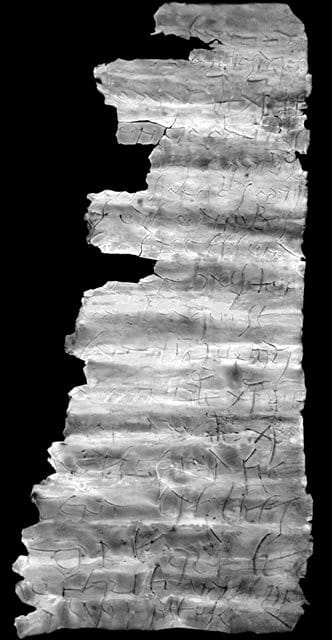
(In the name?) of Saint Titus.
Holy, holy, holy!
In the name of Jesus Christ, Son of God!
The Lord of the world
resists with [strengths?]
all attacks(?)/setbacks(?).
The God(?) grants
entry to well-being.
May this means of salvation(?) protect
the man who
surrenders himself to the will
of the Lord Jesus Christ, Son of God,
since before Jesus Christ
every knee bows: those in heaven, those on earth
and those
under the earth, and every tongue
confesses (Jesus Christ).
Normally, amulets from this period contain inscriptions with a mixture of different faiths, invoking various gods to ward off evil. The Frankfurt amulet’s inscription is purely Christian, and is evidence that Christianity had spread to Germany by the middle of the third century.
Source: https://frankfurt.de/aktuelle-meldung/meldungen/frankfurter-silberinschrift/
2. Latest Excavations at the Grotto at Caesarea Philippi Suggest the Site Was Converted into an Outdoor Banqueting Hall by Herod Agrippa II
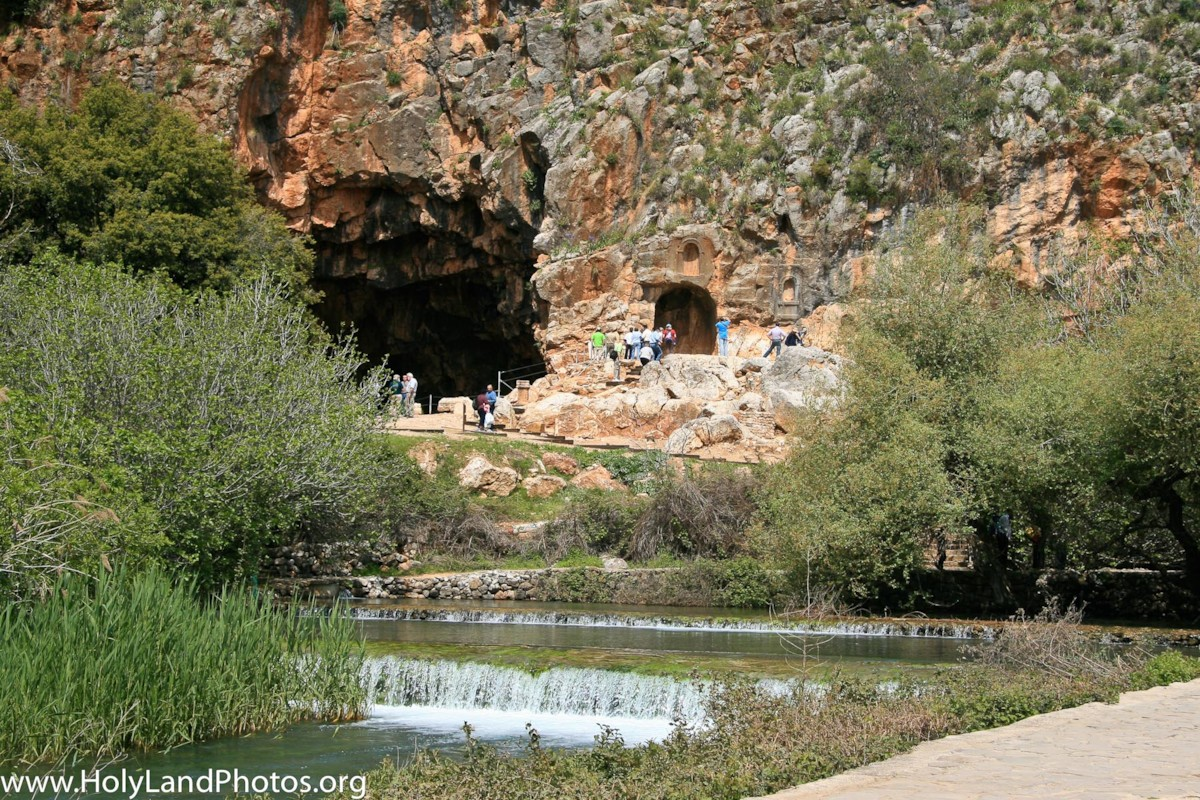
The most recent excavations at Banias (also called Paneas and Caesarea Philippi) suggest that the area in front of the famous cave associated with the cult of the god Pan was repurposed as an outdoor banqueting area by Herod Agrippa II. The results of the excavations, conducted in 2020 and 2021, were published in the November 2024 issue of the journal, Bulletin of the American Society of Overseas Research, published by the University of Chicago Press. The authors of the study report that sometime after AD 70, Agrippa constructed an open-air nymphaeum-triclinium facing the cave, which was filled with water. A stone in the middle of the pool in the cave likely had a statue on it. An aqueduct controlled the level of the water in the cave and allowed water to flow out around a central dining area. This type of outdoor dining area surrounded by water was popular in and around Rome in the first century. Jesus once took his disciples to Caesarea Philippi and asked them who people said that He was. He then asked his disciples, “But who do you say that I am?” to which Peter replied, “You are the Christ, the Son of the living God” (Mt 16:13–16).
Source: https://www.journals.uchicago.edu/doi/10.1086/731707
1. New Structures Discovered at Sargon II’s Capital City of Dur-Sharrukin
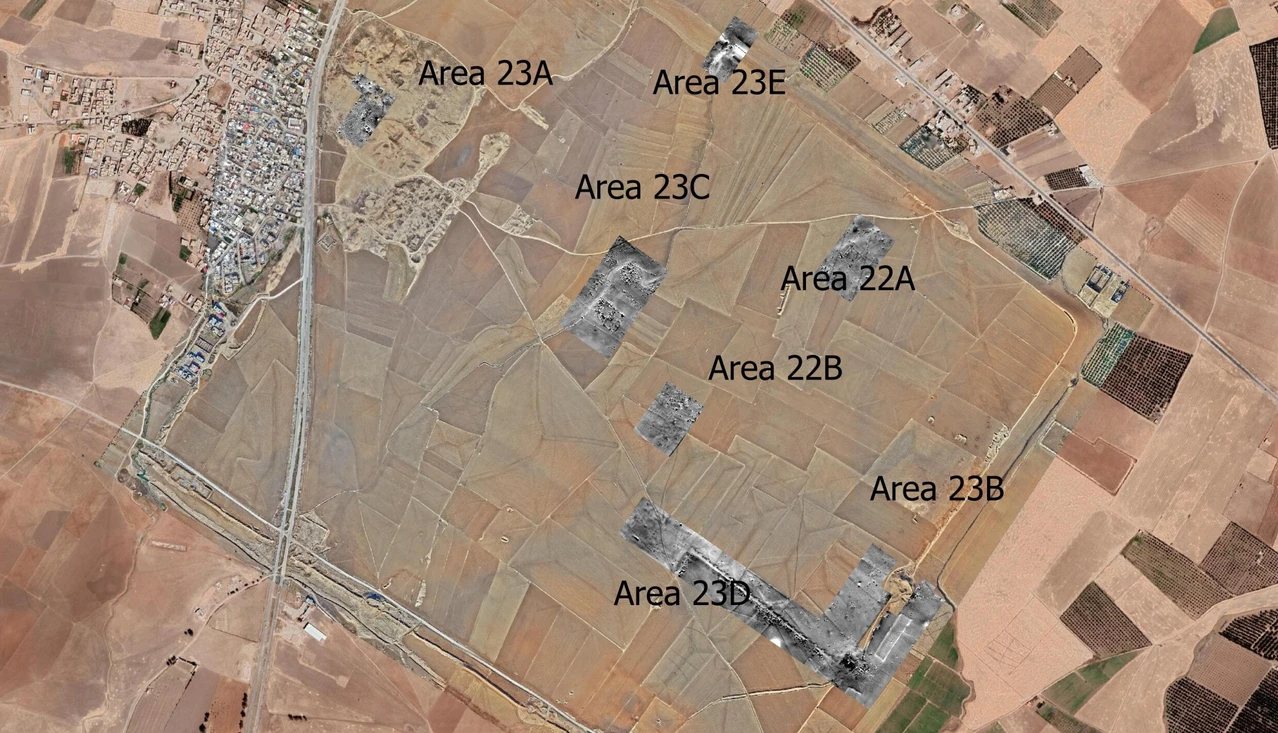
At the recent annual meeting of the American Geophysical Union (AGU), scholars presented research demonstrating that Sargon II’s capital city of Dur-Sharrukin was larger and more complete than previously thought. Dur-Sharrukin, located at modern Khorsabad in northern Iraq, was excavated in the 1800’s and 1900’s. Impressive remains were discovered in Sargon’s palace, but little was found elsewhere at the site, leading archaeologists to conclude that, apart from the palace complex, the construction of Dur-Sharrukin was never completed. Upon Sargon’s death, his son Sennacherib moved the Assyrian capital city to Nineveh. Recently, a team from the Ludwig-Maximilians-University of Munich, the Paris Panthéon-Sorbonne University, and the University of Strasbourg used a high-resolution magnetometer to map parts of the site, providing X-ray-like images of the structures underground. Their work revealed the city’s water gate, the palace gardens, city walls, and five large buildings, including a 127-room villa that is twice the size of the U.S. White House. The authors of the study conclude that Dur-Sharrukin was far more complete than previously thought and was, at least for a period of time, an active city. Sargon II is mentioned in Isaiah 20:1, where his attack and capture of Ashdod is described.
Source: https://news.agu.org/press-release/abandoned-assyrian-capital-revealed/
Stay Up-To-Date
Get the latest BREAKING NEWS in biblical archaeology each week here: https://biblearchaeology.org/current-events-list

 Bible Archaeology Report