

The top three reports from the world of biblical archaeology in July 2025 included discoveries related to flint, clay, and human remains from Israel and Egypt.
3. Flint Workshop from the Early Bronze Age Discovered in Southern Israel
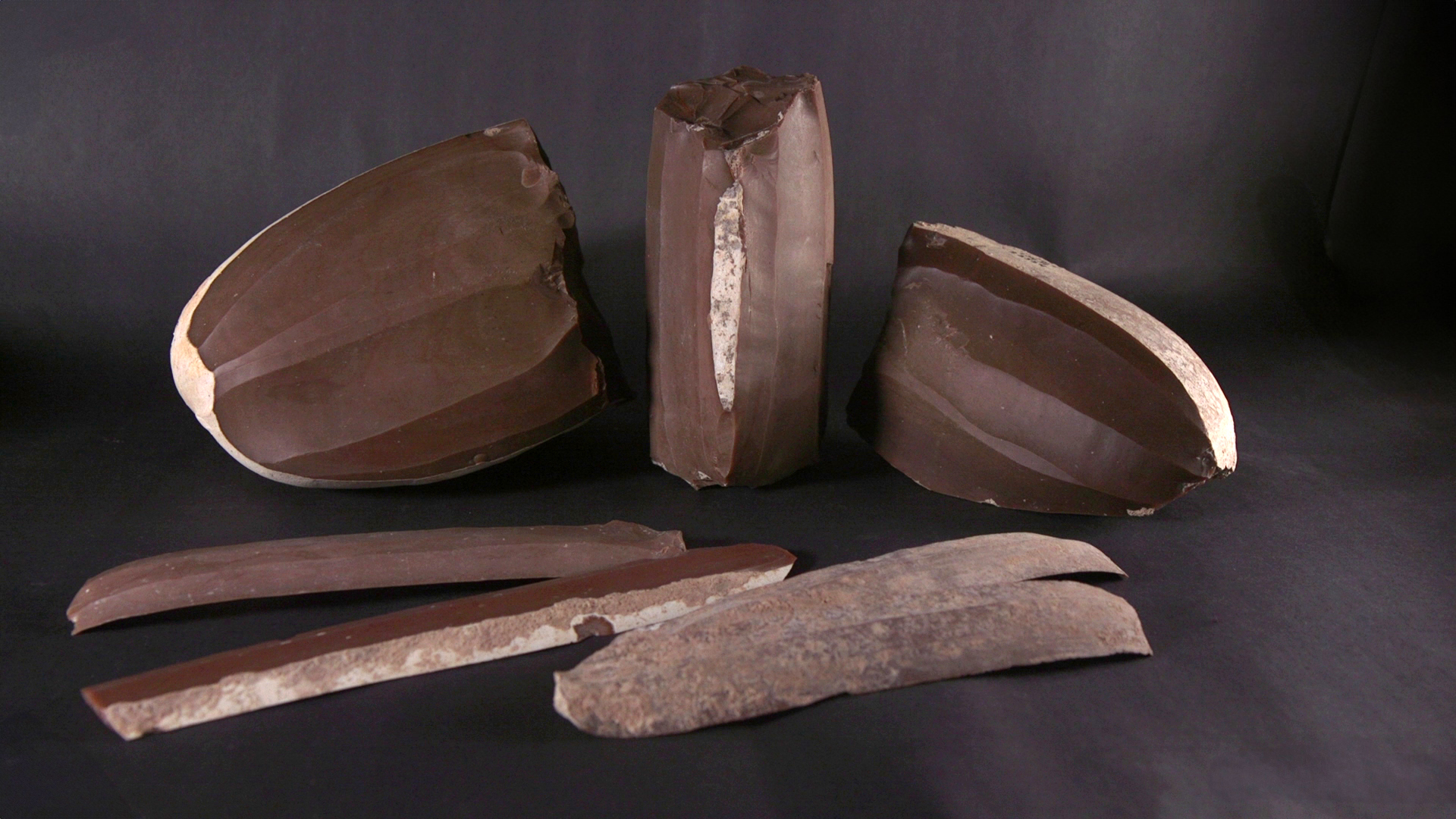
The Israel Antiquities Authority (IAA) recently announced that, during preparations for the construction of a new neighborhood at Naḥal Qomem (also known as Gat-Govrin or Zeita), a 5,500-year-old flint workshop was unearthed. The excavations produced various significant finds, including long flint blades, as well as large stone cores used to produce them (a rare find). The excavation directors—Dr. Martin David Pasternak, Shira Lifshitz, and Dr. Nathan Ben-Ari—are quoted in the IAA’s press release (see below) as stating,
The discovery of a sophisticated workshop indicates a society with a complex social and economic structure already at the beginning of the Early Bronze Age. This is an important find in that it deepens the understanding of both the beginnings of urbanization and of professional specialization in the Land of Israel—phenomena that led to the establishment of large settlements and that catalyzed the creation of new social structures.
The rise of urbanism in the Early Bronze Age is reflected in Genesis 10, the Bible’s “Table of Nations.”
Source: https://www.iaa.org.il/en/page/news-index (See An ancient blade manufacturing workshop was uncovered in Kiryat Gat—The first ever discovered in southern Israel, [July 27, 2025])
2. Researchers Sequence the Genome of a Man from Ancient Egypt

courtesy of the Garstang Museum of Archaeology, University of Liverpool. Morez Jacobs, A. et al. Nature (2025)
For the first time, researchers have sequenced the genome of a man from ancient Egypt, whose remains date to the 3rd millennium BC. The results indicate that he had links with both North Africa and Mesopotamia. The human skeleton was discovered at Nuwayrat, located near the village of Beni Hasan, 165 miles (265 km) south of Cairo. The remains were contained in a pot, which may have been the reason why enough DNA had been preserved to study. According to the study (see link below), the skeleton was carbon dated to 2855–2570 cal BC, meaning the man lived a few centuries after Egyptian unification, straddling the Early Dynastic Period and the Old Kingdom. The genetic sequencing revealed that 80% of his ancestry was from North Africa, while 20% came from the Fertile Crescent, including the region of Mesopotamia. The authors of the study conclude that contact between Egypt and Mesopotamia was not limited to artifacts alone, but that there was also a level of human migration. According to a straightforward reading of biblical chronology, Abraham was born in the Early Bronze Age and lived into the Intermediate Bronze Age. The Bible records that he was from Mesopotamia (Gn 11:28-31) and that he migrated to Egypt for a time (Gn 12:10).
Source: https://www.nature.com/articles/s41586-025-09195-5
1. Bulla Inscribed with Biblical Name Discovered by Temple Mount Sifting Project

The Temple Mount Sifting Project (TMSP) has announced the discovery of a clay bulla (seal impression) bearing an inscription with a biblical name. The bulla dates paleographically to the 7th or 6th century BC and reads, “Belonging to Yed[a‛]yah, son of Asayahu.” A man named Asayahu who served King Josiah is mentioned in two places in the Bible (2 Kgs 22:12; 2 Chr 34:20). The name on the bulla is the same as the one in the Bible, though it appears here in its longer form; the shorter (Asaya) and longer (Asayahu) versions were used interchangeably in antiquity. The name Asayahu is also attested on another bulla that surfaced about 20 years ago, accompanied by the words “servant of the king.” However, because that bulla appeared on the antiquities market, its authenticity remains uncertain. The bulla discovered by the TMSP comes from an archaeological context, albeit one that had been disturbed. The TMSP has been sifting through thousands of tons of soil removed from the Temple Mount in 1999 and dumped in the Kidron Valley. While it is impossible to conclusively state that the TMSP bulla refers to the same official who served in King Josiah’s court in the late 7th century BC, it does confirm that the name was in use at that time.
Stay Up-To-Date
Get the latest BREAKING NEWS in biblical archaeology each week here: https://biblearchaeology.org/current-events-list

 Bible Archaeology Report
Thank you Dr. Windle for doing the work to bring the Bible Alive. Always Enjoy your top 10 on digging for truth, keep on keeping on…